
Lifeline Household Worksheet 2026: Separate Households Explained
Two people can live at one address without being one Lifeline household. What matters is whether they share income and household expenses.
This guide explains the one-per-household rule, when FCC Form 5631 is needed, and how to answer the worksheet without guessing.
Quick answer: The Lifeline Household Worksheet, also called FCC Form 5631, helps determine whether multiple people at the same residential address belong to separate economic households. Lifeline allows only one benefit per household, but an address can contain more than one household. USAC may require the worksheet when another subscriber at your address already receives Lifeline. Sharing a building is not by itself disqualifying. Sharing a household budget can be.
For someone who rents a room, lives with relatives, or shares a house with other adults, this distinction matters. An application may raise a duplicate-address question even when the applicant has an entirely separate financial life from the existing subscriber. The worksheet gives USAC a way to review that situation instead of treating every matching street address as one household.
What counts as a household for Lifeline?
USAC defines a Lifeline household by its economic relationship: people who live together and share income and living expenses. A household can include relatives or people who are not related. Conversely, people at one address may be separate households if they function as separate economic units.
That means the number of names on a lease, the number of bedrooms, or the number of mailboxes does not settle the question by itself. The important issue is whether adults contribute to and share a common pool of money for their living expenses. Relevant expenses can include rent or mortgage payments, utilities, food, and healthcare. Income can include wages, government benefits, pensions and other resources.
For example, two adult roommates who manage separate finances and do not share their income and expenses may be separate Lifeline households. But two adults who pool earnings and pay their living costs together may be a single economic household even if they are not family members. Read USAC’s official one-per-household explanation before treating an address match as an automatic rejection.
Same address, different households: realistic examples
The worksheet is easiest to understand by looking at how people actually pay their bills. The examples below show the factors that matter. They are explanations of the rule, not approvals for any particular person.
| Living arrangement | Financial arrangement | Likely household treatment |
|---|---|---|
| Married couple living together | They live as one married household. | Generally one household and one Lifeline benefit. |
| Parent and dependent child | The adult supports the child’s household needs. | Generally the same economic household. |
| Four independent roommates | Each manages separate money and does not share income or expenses with the others. | May be four households. USAC’s worksheet uses this type of example. |
| Two unrelated adults sharing a budget | Income is pooled and expenses are paid jointly. | Generally one economic household. |
| Adult child living with parents | Depends on whether the adult is financially supported or shares household money. | Not decided by age alone. Review actual financial arrangements. |
| Separate families in one building | Each has its own financial household with no shared income and expenses. | They may qualify as separate households if each meets the other Lifeline rules. |
| Adults sharing a lease or utility bill | Some bills are shared, but other financial arrangements are separate. | Needs careful, truthful review. Contact Lifeline Support when uncertain. |
USAC’s own Household Worksheet lists roommates who do not share money and residents of assisted-living facilities who maintain independent finances as examples of separate households. The form also identifies a married couple and a parent with a dependent child as examples of one household. Those examples explain the rule, but they do not replace the complete eligibility review.
When is the Lifeline Household Worksheet required?
You do not need to complete Form 5631 simply because you are applying for Lifeline. The worksheet is relevant when the system identifies a potential duplicate at your residential address. This can happen when an existing subscriber already receives Lifeline at the same address or when more than one subscriber is registered there.
USAC says a duplicate-address application can be resolved by demonstrating that the applicant is an independent economic household. Completing the Household Worksheet is the official route for that determination. The USAC National Verifier guidance on duplicate addresses explains why the additional information is requested.
The worksheet is not a way to receive two benefits within the same household. A household cannot claim separate benefits merely by listing two names, using separate cell phones, or choosing different participating providers. The one-benefit limit still applies.
How to complete FCC Form 5631, page by page
The official Household Worksheet is a four-page form with instructions, identifying information, household questions, and an agreement. Get the current English or Spanish version from Lifeline Support’s Forms and Tools page or the USAC Lifeline Forms list. Use the version provided with your application or requested by the administrator.
Page 1: Understand the one-per-household rule
Start by reading the definition. The form explains that a household consists of people who live together and share income and expenses, even when they are not related. It also gives examples showing when several people at a single address may be separate households. This page helps you understand the questions that follow.
Page 2: Enter your legal name and residential address
Use your legal name exactly as it appears on official records, not a nickname. Enter the home address where you receive service, including an apartment or unit number when applicable. A post office box is not a residential street address for this purpose. For a paper form, USAC instructs applicants to use capital letters and black ink.
Page 3: Answer the household questions honestly
The worksheet asks whether you live with another adult, whether that adult receives Lifeline, and, when applicable, whether you share money with that person. Sharing money includes income and expenses. Follow the arrows or instructions for your answers. A person whose household already receives the Lifeline discount cannot use the worksheet to create a second benefit for the same household.
- Does another adult live at this address? The form includes adults age 18 or older and emancipated minors in this question.
- Does that adult already receive Lifeline? You may need to clarify the situation if a benefit is already associated with the address.
- Do you share income and household expenses? Consider recurring financial support, pooled money, housing costs, food, utilities, and other living expenses.
Page 4: Initial, sign and date
Depending on your answers, the form may require you to initial the statement that you live at an address with more than one household, and the statement acknowledging the federal one-per-household rule. Follow the form’s specific instructions, then sign and date it. Leaving required initials or a signature blank can delay processing.
USAC’s National Verifier application instructions explain how consumers can complete the online process or mail official forms. Follow the directions given for your particular case; Oregon and Texas have different state administration arrangements.
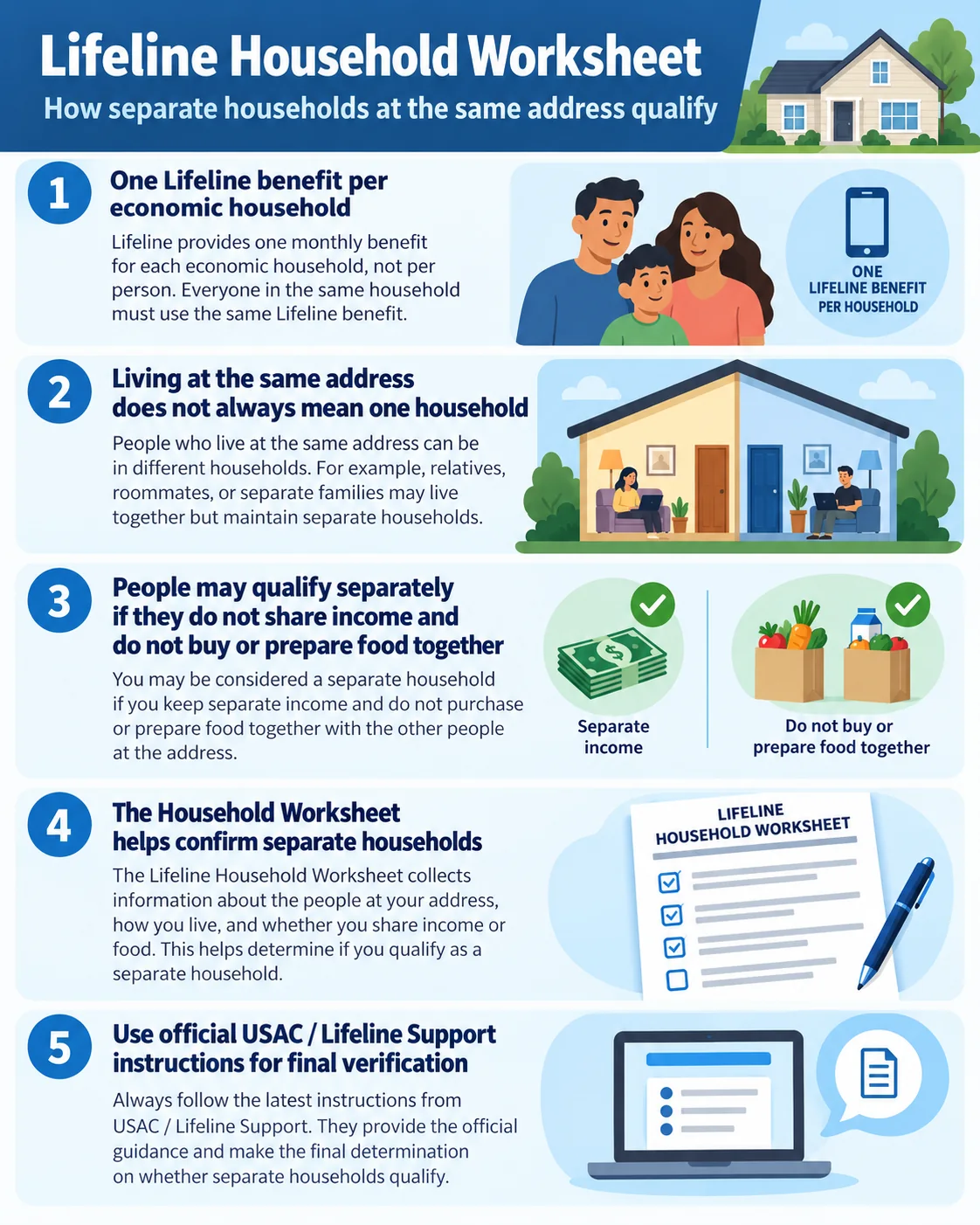
Does sharing groceries, rent or utilities make you one household?
This is where people often get stuck. A roommate might buy their own groceries but contribute to the same electricity bill. An older relative might pay no rent but receive regular financial support from other adults in the home. Another pair of roommates may each pay a landlord separately and otherwise keep their expenses completely apart.
USAC describes household expenses broadly, including food, healthcare, rent, mortgage costs and utilities. That is why looking at groceries alone is not enough. The full arrangement matters. An occasional meal together is different from routinely pooling funds, and a shared bill may raise questions that require explanation. A single purchase or payment does not settle the full economic-household question.
To prepare for a household question, write down who earns or receives income, who pays the major recurring bills, and whether adults financially support one another. You may never need to submit this personal breakdown, but it can help you provide consistent answers on the official form. If you’re uncertain whether shared expenses make you one household, contact Lifeline Support before signing a certification.
Worked example: two people at one residential address
Alex and Jordan rent separate rooms at the same street address. Neither receives money from the other, their incomes are separate, and they pay their regular living costs independently. Jordan already has a Lifeline-supported service plan. Alex applies for Lifeline and receives a duplicate-address question.
Alex should not choose a different address or hide Jordan’s existing benefit. Instead, Alex can review the Household Worksheet, answer the questions about independent finances accurately, and submit it through the requested official process. USAC then reviews whether the two people are separate economic households. The worksheet helps resolve the address question; Alex must still qualify through income or an accepted assistance program.
For comparison, if Alex and Jordan pooled their income and paid their living expenses together, they would be one economic household under the Lifeline rule, even though they were not related. That household could receive only one benefit.
For 2026, USAC’s published income limit for a one-person household in the 48 contiguous states and DC is $21,546 annually (135% of the Federal Poverty Guidelines). A separate household’s income is evaluated according to its own household size and qualifying records. Check the 2026 Lifeline income calculator or USAC’s official eligibility table. The worksheet does not remove the income or program-participation requirement.
What if the address already has a Lifeline subscriber?
A matching address can occur for legitimate reasons. It might be a multi-family home, a shared residence with separate adult finances, or an apartment whose unit number was entered inconsistently. It can also signal that a member of the applicant’s own household already receives a discount, in which case another benefit is not permitted.
First check that your address and apartment or unit information are complete. If the other subscriber belongs to an independent economic household, use the Household Worksheet as instructed. If you do not know who the existing subscriber is, follow official support guidance rather than guessing or copying someone else’s information. Do not alter your address to make an error disappear.
If you recently moved, keep your provider updated with your correct address. The Lifeline program requires subscribers to report certain changes, including moving or no longer qualifying. For guidance on other account responsibilities, see our 2026 recertification guide.
Common mistakes that delay household verification
- Using a nickname: Enter the legal name that matches your eligibility documents.
- Leaving out a unit number: Include the accurate apartment, suite or unit where applicable.
- Assuming unrelated means separate: Roommates who share income and expenses may still be one household.
- Assuming related means one household: Separate adult economic households may share an address even when people are related.
- Skipping initials or signature: Finish the agreement items indicated by the worksheet.
- Using an old or unofficial form: Get the current worksheet from USAC or Lifeline Support.
- Sending documents to an unknown website: Use the authorized application or state administrator channel.
Keep a copy of your completed paperwork and any official acknowledgement. If the system still flags your address after you submit the worksheet, contact Lifeline Support with your application information. For identity, address and documentation problems, USAC’s error-resolution instructions explain the accepted process.
Can the worksheet approve you for a free phone?
No. The worksheet decides whether the one-benefit-per-household limitation might affect a Lifeline application. It is not a phone order, a carrier enrollment form or a guarantee of a device. Eligibility verification is separate from the provider’s service plan and any device offer.
Households choosing a participating carrier should review network coverage, the monthly plan, any device charge, and whether an existing unlocked phone can be used. Our SafeLink Wireless review explains one carrier’s published terms, while the Assurance versus SafeLink comparison provides a side-by-side perspective. Neither replaces an official eligibility decision.
Lifeline Household Worksheet FAQs
Can two people in the same house get Lifeline?
Possibly. They must belong to separate economic households, each independently meet Lifeline eligibility requirements, and complete any requested Household Worksheet. Two members of the same household cannot each claim a discount.
What form is the Lifeline Household Worksheet?
It is FCC Form 5631. USAC provides an English and a Spanish version through its official forms and consumer tools pages.
Does sharing a mailing address mean my application will be denied?
No. A matching address can prompt extra verification. USAC uses the worksheet to distinguish a duplicate within one household from independent households at a shared address.
Can adult siblings living together be separate households?
They may be, if they actually maintain separate economic households. Their relationship by itself does not resolve whether income and expenses are shared. The facts on the worksheet matter.
Can a married couple apply for two Lifeline benefits?
The official worksheet treats a married couple who live together as one household. They generally share one Lifeline discount, not one each.
Do I need a separate kitchen to be considered another household?
The published Lifeline definition focuses on shared income and expenses, not a requirement for a separate kitchen. Describe your actual financial arrangement if USAC asks you to complete the worksheet.
Does the form ask for proof of income?
The Household Worksheet addresses the one-per-household issue. The National Verifier may separately request proof of program participation, income, identity or address to establish general eligibility.
What should I do if the worksheet question is confusing?
Contact the Lifeline Support Center at (800) 234-9473, as published by USAC. Support representatives can explain the household worksheet and other application requirements. For suspicious requests, read our Lifeline consumer protection guide.
Official sources and forms
Use these primary sources for the current definition of a household, the worksheet, and any application questions.
- USAC: Consumer Eligibility — one-benefit-per-household rule, qualifying programs and 2026 income limits.
- USAC: Official Lifeline Forms — FCC Form 5631 and its purpose.
- Lifeline Support: Forms and Tools — English and Spanish Household Worksheet downloads.
- USAC: Resolve Application Errors — duplicate-address issues and documentation.
- USAC: Contact Us — Lifeline Support Center contact details.
Editorial note: Valid Wireless is an independent consumer information website. Our editorial research team reviewed official USAC and Lifeline Support material on October 30, 2026. The Household Worksheet infographic is explanatory artwork, not an official federal form. The federal program or applicable state administrator makes eligibility decisions; Valid Wireless does not accept or process applications or personal verification documents.